
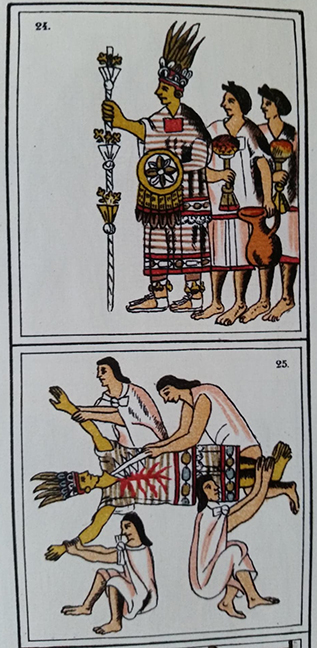
On the first day of this month they celebrated a feast to the female Teteoh of salt, whom they called Wixtoziwatl. They said that she was the elder sister of the Tlalokeh. In honor of her, they slew her female representation (ixiptla).
From the Florentine:
“On the eve of this feast, all the old women sang and danced, as well as the young women and girls. They went held by some short cords which they carried in their hands, one [taking] one end, another the other [end]. These cords they named xochimekatl. They all wore garlands of wormwood [flowers] of this land, which are called iztawiatl. Several old men led them and ordered the singing. Among them went the woman who was the likeness of this goddess and who was to die arrayed in rich ornaments.
On the night before the feast, the women, with the same one who was to die, kept vigil; and they sang and danced all night long. At break of day, all the priests arrayed themselves and performed a very solemn dance. And all who were present at the dance held in their hands those flowers which are called zempoalxochitl. Thus dancing, they took many captives to the teokalli of Tlalok, and, with them, the woman who was to die, who was the likeness (ixiptla) of the goddess Wixtoziwatl. There they slew first the captives and then her.
Many other ceremonies were performed during this feast; and also [there was] great drunkenness, all of which is set forth at length in the account of this feast.”
Book 6 chapter 7 p 33
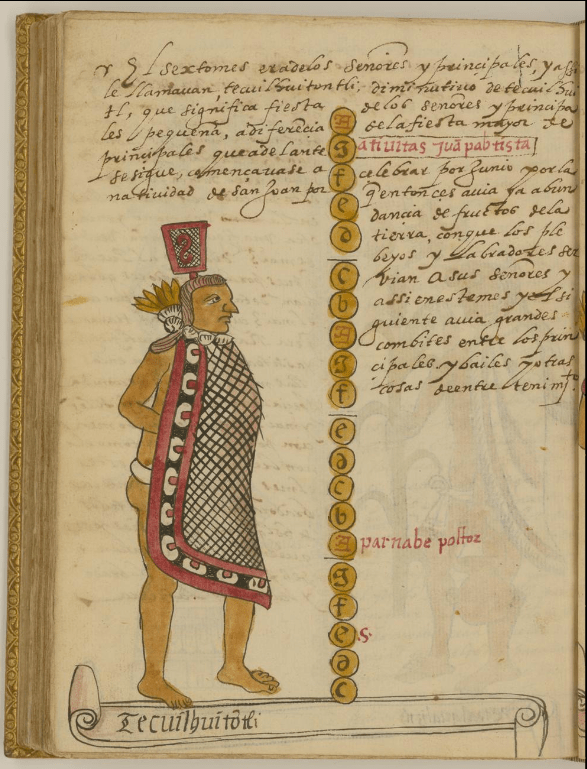
Modern Interpretations of Tekuilwitontli (adapted with permission from the work of micorazonmexica):
Today there is no longer a class of noblewomen to celebrate Tekuilwitontli in the ancient way. But, falling as it does in the heart of Xopan, during the period when the power of the mother/creation Teteoh are at Their height, it is appropriate for all women to celebrate their many gifts, and for men to honor them and join in their feasting. A tlamanalli (ofrenda) should be made on which the Teteoh are arrayed, beneath a bower of flowers, and offerings of food placed before them. The women should wear their most beautiful regalia in a thousand colors, and paint their arms and faces yellow, with red lips and spots of red upon their cheeks, while the men, if men are present, should dress simply, in white. Amaranth cookies shaped like moons and rabbits, cooked squash-blossoms on blue-corn tortillas, tamales, and other delicacies, are served at a feast, in which the women first dance with one another, and only after permit the men, if they should deign to invite men, to join them.
Tekuilwitontli is also sacred to Wixtoziwatl, Salt Woman, who is Our Lady Salt, Our Lady the Sea. She is a sister of the Tlalokeh, who at the dawn of time battled with Them. She was defeated, and cast into the sea, and Her body of salt dissolved and became the brackish lakes and the water in the ocean. During the season of rain, we give honor to Our Mother the Sea, for without Her we cannot live, and She is honored for Her life-giving salt. If you live near the sea, you should go to the seashore, and give offerings and ceremonies to Her. We have mistreated Her with pollution, endless rivers of plastic, overfishing, and all of the other cruelties we have thoughtlessly inflicted upon Her. She is angry, and now threatens to flood all the shores of the world. Give Her praise and thanks for Her abundance, dance for Her, cast drops of your blood into Her waves, and brilliant flowers which give Her joy, and then volunteer to pick up trash, or save sea-turtles, or give up eating non sustainable sea-food, or donate money, or in some other way sacrifice for Her, and give back to Her some small part of what She has given to you.

 The Mexika Calendar System