Monthly Rituals

Tozoztontli

Tozoztontli – “the Small Vigil”

The second Zempowaltonallapowalli is known as Tozoztontli, “the Small Vigil.” It is the first of two “months” devoted to honoring the Lords of Maize. During Tozoztontli, the fields are prepared for the coming rains of Xopan (the wet season), and offerings are made to Xilonen, Chikomekoatl, and Zinteotl, the Lords of Maize. We ask them to return to us, to paint the fields green, and to give us their treasure of life and corn. We make offerings to Tlalok and the Tlalokeh, because during Tozoztontli they begin to awaken from their slumber to bring us their waters once more. And finally, we give honor to Koatlikwe, our Mother the Earth, for it is from her body that the Lords of Maize will grow.
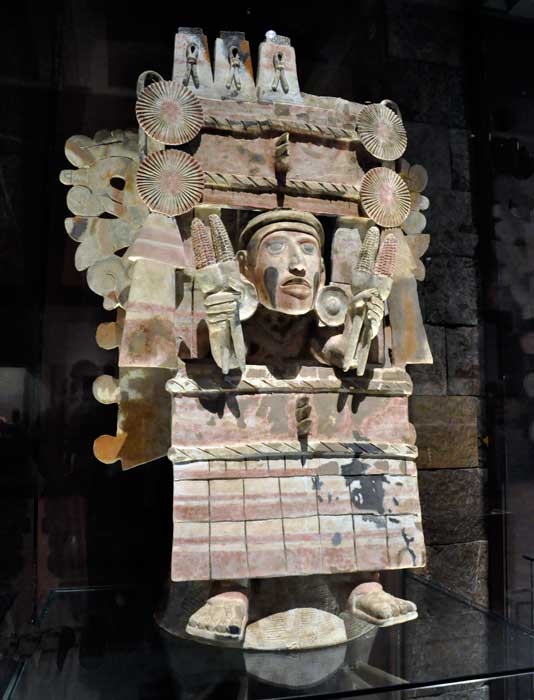
Mexica (Aztec) incense burner with Chikomekoatl, from Tlahuac, Mexico City, c. 1325-1521, terracotta and pigment, height 105 cms., National Museum of Anthropology, Mexico City.

From the Primeros Memoriales (Page 57):

“At this time flowers were offered, and roasted snakes were offered. It was called “the offering of flowers” because all the diverse flowers first bloomed; therefore, they were offered. And it was called “the offering of the roasted snakes” because snakes were roasted in the fire. They were offered thus: the offerings were set down; the offerings were made in the temple of the devil. And if someone were to catch a snake, he would not yet eat it. Later, after the offering of the roasted snakes was made, he could then eat it. It was the same with the flowers. No one could cut them without first making an offering of them.”
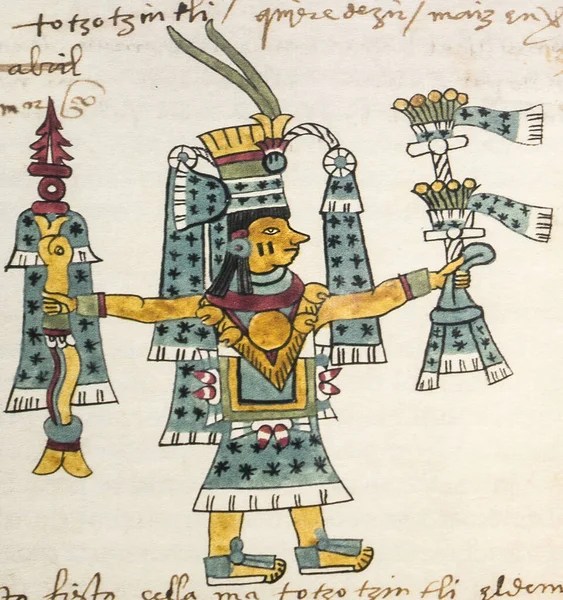
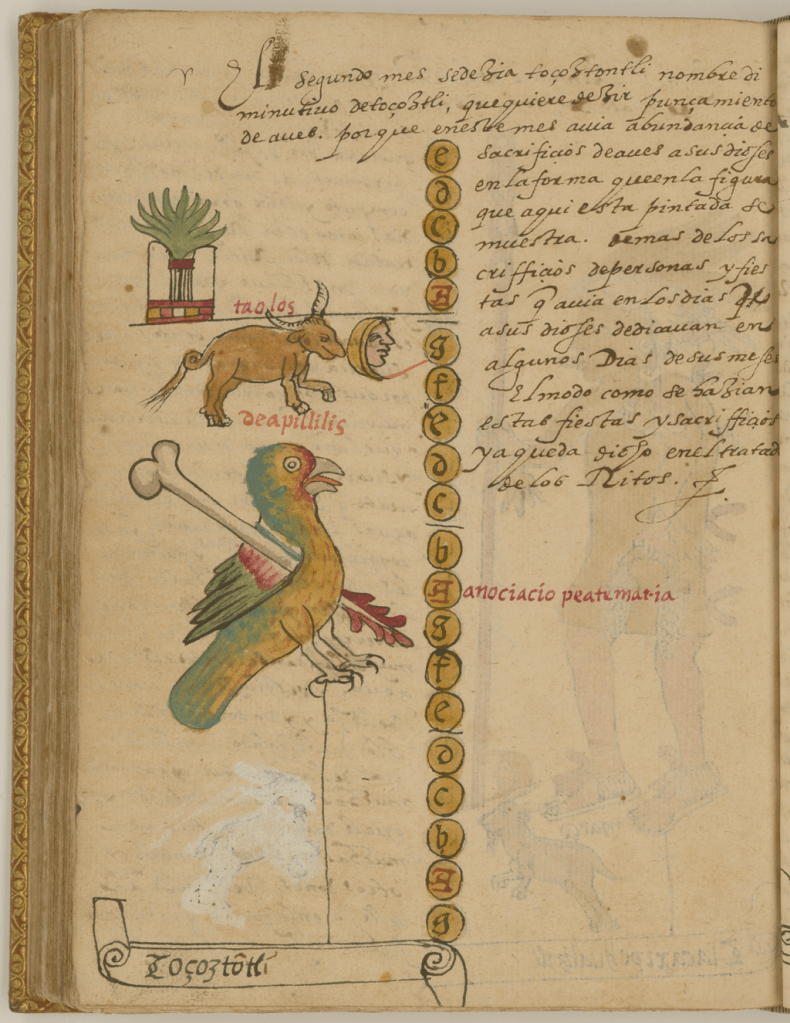
Month Tozoztontli in Aztec calendar. Codex Tudela, 16th-century pictorial Aztec codex. Folio 98v. Museum of the Americas, Madrid, Spain

From the Florentine Codex (Book 2, Page 57):

“And flowers were offered. Hence was it said: “Flowers are offered.” For all the various flowers which for the first time blossomed, the flowers which came first, the flowers which came ahead, were then given as offerings. No one first smelled them unless he would first make an offering, would give them as gifts, would lay them out as offerings. They were whatever small flowers they saw which spread out blossoming, spread out bursting, spread out popping into bloom-the flowers of spring. Small, little, tiny, minute ones, no matter how many, no matter how little, no matter how small, no matter how tiny, they bound them each together at the ends; they bound them up.

And to look for the flowers, they all went together to the fields to bring them in, although some of the field people sold them here. And when this was done, they ate tamales of wild amaranth seeds. Especially the Koateka, they who belonged to the Kalpulli of Koatlan, venerated this feast day. They made offerings to their deity called Koatlikwe or Koatlan Tonan. They placed their trust in her; she was their hope; they depended upon her; she was their support. To her they lifted their voices.”

Modern Interpretations of Tozoztontli (adapted with permission from the work of micorazonmexica):

In the cornfield or garden where the corn is raised, a small pile of stones is made and adorned with paper flags, and spattered with liquid rubber or ink, over which pulque, tequila, or mezcal is poured and to which flowers and food are offered, for they are the bones of Our Mother the Earth and are symbolically the seeds from which the maize will grow. Strings are tied between the trees which surround the field, from which are hung paper flags, clay medallions of corn, flowers, and beneficial insects like bees, or images of Tlalok and the Tlalokeh and the Lords of Maize. The fields are cleansed with the smoke of Kopal and the sound of conch shells. All these things prepare the field for the coming of the rain, and for the corn and other things raised in the fields to flourish. Flowers and dried maize plants from last year’s harvest are brought back to the home, and decorate the tlamanalli, and snakes are cooked and left upon the alter, and later eaten, as an offering to Koatlikwe, She of the Skirt of Serpents, who is one of the many Earth-Mother-Creation Teteoh.  
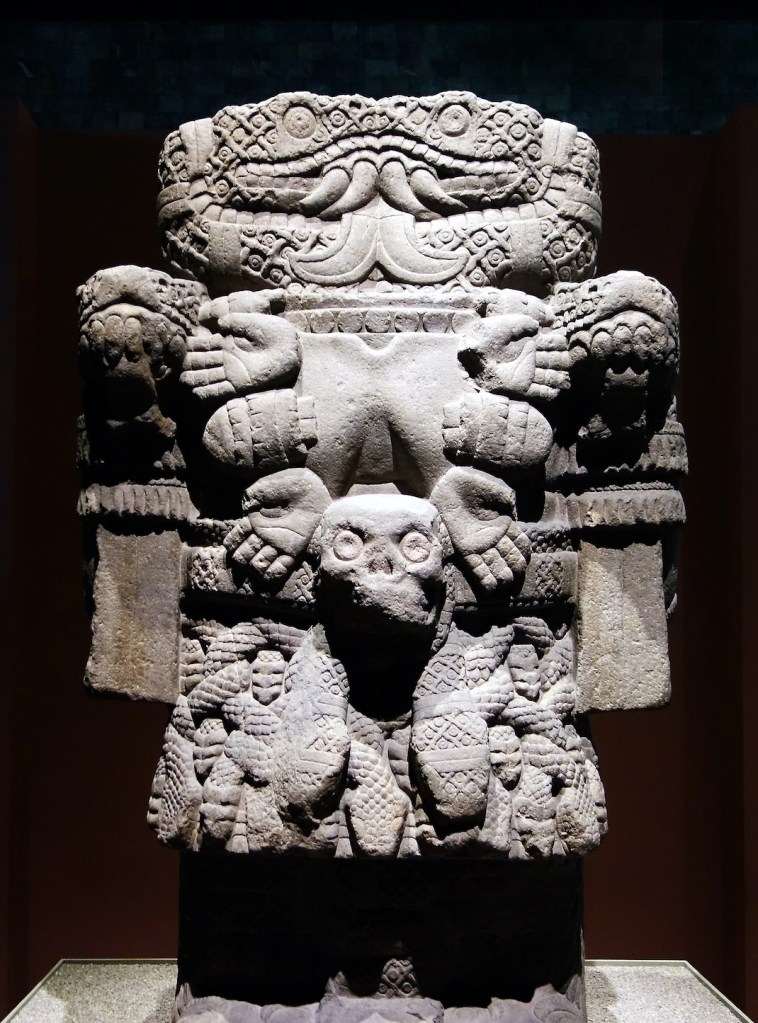
Coatlicue, c. 1500, Mexica (Aztec), found on the SE edge of the Plaza mayor/Zocalo in Mexico City, basalt, 257 cm high (National Museum of Anthropology, Mexico City;

Most of the ceremonies and activities of Tozoztontli take place in the field or garden where the maize plant is grown. For those of us who live in urban environments, far from the places where the Lords of Corn grow, the ceremonies might take place in a park or other outdoor location, for although we are far from the natural processes of the growth of maize, we still depend upon the corn to feed and sustain us, and we still owe the Lords of Maize our gratitude and must pay our debt. The ceremonies will no longer serve to bless the fields where the corn is grown, and thus help to ensure a successful harvest, but they will help us to give praise and thanks to the corn for their gift of life to us and allow us to align our hearts with them and with Our Mother the Earth. Therefore, build your tlamanalli to the Teteoh honored during Tozoztontli, and pile it high with dried ears of corn. Cook dishes with corn and cleanse them with the smoke of Kopal before you eat them, and hang the strings hung with paper flags and clay and paper images from a tree in your garden or the park, or around the room where you will celebrate the ceremonies. With your family and friends, give thanks to the Lords of Maize, for They are soon to be born, soon to grow, and soon to die, for our sake and the sake of all humanity. 
Tozoztontli, Codex Tovar
Monthly Rituals

Tlakaxipewaliztli

Tlakaxipewaliztli – “People are Flayed”

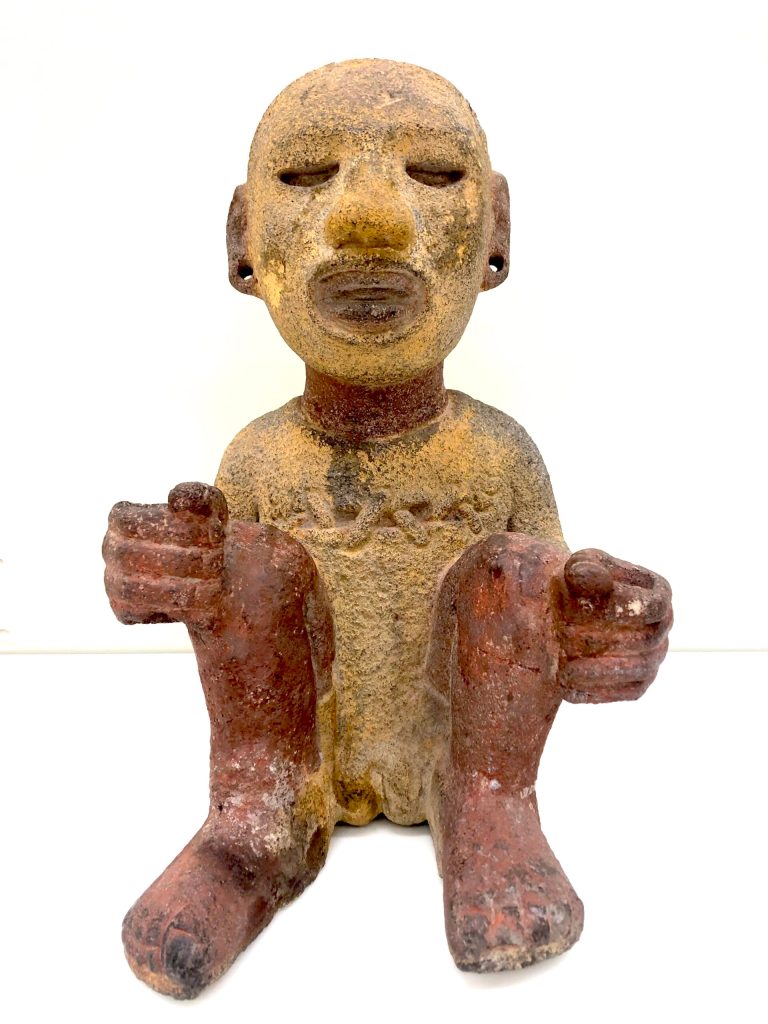
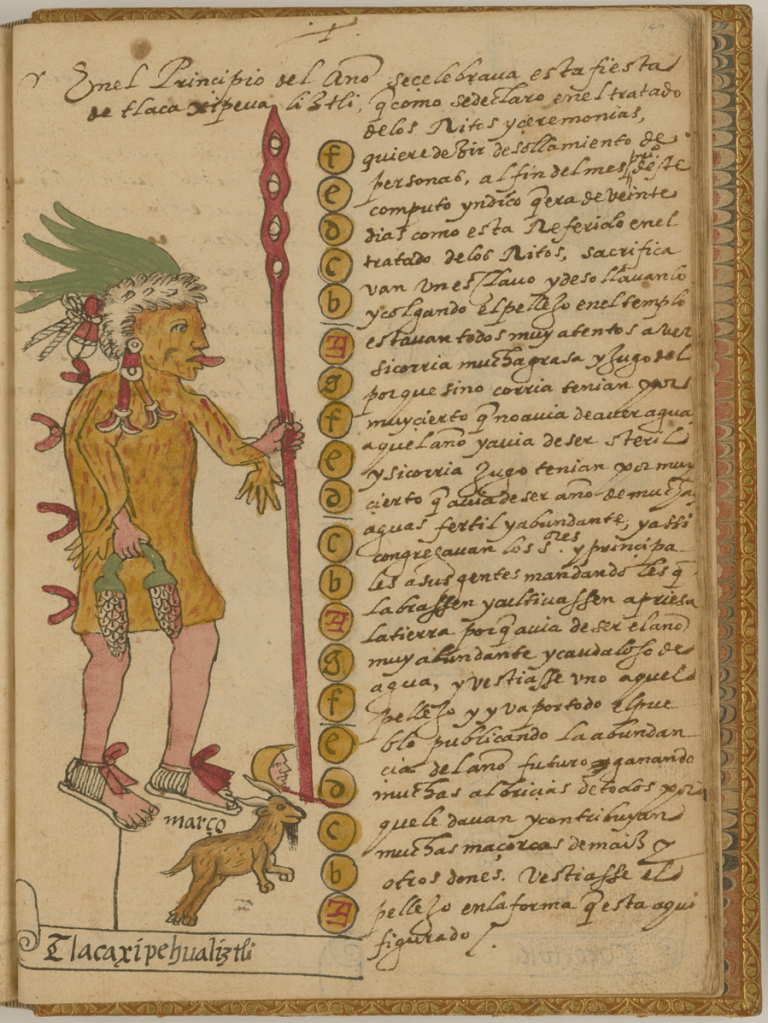
Tlakaxipewaliztli is the first “month” or zempowaltonallapowalli of the solar and ritual year. It begins at sunrise on the day following the observed Spring equinox as measured by the Templo Mayor in Mexiko-Tenochtitlan. Tlakaxipewaliztli signifies the shift from the masculine essence embodied by Ometekuhtli, characterized by heat, drought, warfare, and hunting—characteristic of the season of Tonalko—to the season of the reborn earth, rain, cultivation, and agriculture, emblematic of the feminine principle of Omeziwatl and the season of Xopan. During this time, offerings are made to Xipe Totek, the Flayed Lord who is represented adorned in the skin of a flayed man. His attire of skin further evokes the husk of a maize cob, with his living essence underneath akin to ripened corn. Just as corn must shed its husk, Tlakaxipewaliztli metaphorically mirrors the act of flaying—stripping away the Earth’s winter covering.

Xipe-Totec Sculpture, 1400-1500. Kislak Collection, Library of Congress.

From the Florentine Codex (Book 2, Pages 3-4):

“From the captives whom they were to slay the owners themselves tore off the hair of the crowns of their heads and kept it as a relic. This they did in the Kalpulko before the fire.

When the masters of the captives took their slaves to the temple where they were to slay them, they took them by the hair. And when they took them up the steps of the pyramid, some of the captives swooned, and their masters pulled them up and dragged them by the hair to the sacrificial stone where they were to die.

Having brought them to the sacrificial stone, which was a stone of three hands in height, or a little more, and two in width,’ or almost, they threw them upon it, on their backs, and five priests seized them-two by the legs, two by the arms, and one by the head; and then came the priest who was to kill him. And he struck him with a flint knife, held in both hands and made in the manner of a large lance head, between the breasts. And into the gash which he made, he thrust his hand and tore from the victim his heart; and then he offered it to the sun and cast it into a gourd vessel.

After having torn their hearts from them and poured the blood into a gourd vessel, which the master of the slain man himself received, they started the body rolling down the pyramid steps. It came to rest upon a small square below. There, some old men whom they called Kwakwakwiltin, laid hold of it and carried it to their Kalpulko, where they dismembered it and divided it up to eat it.

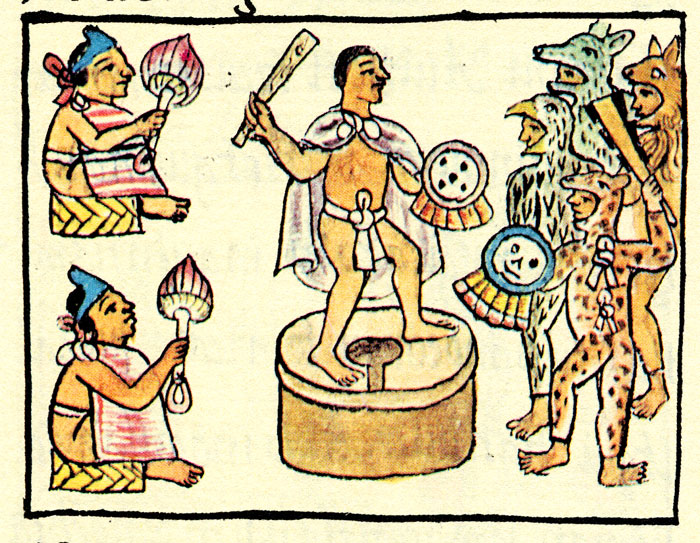
Before they dismembered the captives, they flayed them; and others put on the skins, and, wearing them, fought mock fights with other youths, as if it were a war. And those of one band took captive those of the other band.

After what hath been set forth above, they slew other captives, battling with them-these being tied, by the waist, with a rope which passed through the socket of a round stone, as of a mill; and the rope was long enough so that the captive might walk about the complete circumference of the stone. And they gave him arms with which he might do battle; and four warriors came against him with swords and shields, and one by one they exchanged sword blows with him until they vanquished him. Etc.”

Gladiatorial combat, Florentine Codex (Book 9)

Modern Interpretations of Tlakaxipewaliztli (adapted with permission from the work of micorazonmexica):

If possible, participants fast and make offerings overnight before the ceremony. Their prayer in the dark emulates the seed that grows where the light does not reach, but which trusts that it will be born with the dawn. The next day, a person is dressed in white feathers or papers. He stands in the center of the ceremony, where he performs a dance with a person with the regalia of an eagle and another with the regalia of a jaguar. The dance represents war, the combat between life and death from which the corn emerges triumphant. At the end, the person dressed in white peels a corn cob, a symbol of transformation and renewal, and places it on the altar. Then a game is organized in which this person chases and snatches the tilmas or capes which the attendees wear, simulating the stripping of the corn cob. Those who are left without a tilma must offer something at the altar, such as a song. In exchange, they receive tortillas or cookies in the shape of Xipe and distribute them among the attendees, who consume them. In so doing, they become one with Xipe, who is Spring and Maize, and He is transformed into their very flesh.

Takaxipewaliztli, from the Codex Tovar
Monthly Rituals

Wey Mikailwitl

Prior to the Spanish invasion, Mesoamerican traditions of honoring the dead were celebrated with two specific feasts: Mikailwitl (feast of the dead), and Wey Mikailwitl (great feast of the dead). These feasts were celebrated in early August through mid-September.

Many think that Mikailwitl and Wey Mikailwitl were absorbed into All Saints Day and All Souls Day under the direction of the Catholic Church, as these two Catholic holidays also involve honoring the dead. This popular claim is often repeated without any evidence to back it up. For example, a recently published column about Dia de Muertos at weareyourvoicemag states “in an attempt to convert the natives to Catholicism, the Spanish colonizers moved the celebration to November 1 and 2 (All Saints Day), which is when we celebrate it currently.”

But is this how it really happened?

The process of combining older rituals into another religion is known as Syncretism, and is intended to help ease religious conversion. While Catholic priests often employed syncretism as a strategy of conversion in the “New World,” this is not what happened in regards to the festivals of Mikailwitl and Wey Mikailwitl.

In fact, it was the exact opposite!

The Codex Telleriano-Remensis describes the feast of Mikailwitl on folio 2r:

20171031_105414

Feast1

The Codex Telleriano-Remensis also describes the feast of Wey Mikailwitl on folio 2v:

20171031_105443

Feast2.jpg

The writings of Diego Duran reveal that these Mesoamerican feasts were not moved under the direction of Catholic priests, but were hidden in the feasts of All Saints Day and All Souls Day by the indigenous people themselves. This subversive act of resistance was intended to fool the Catholic priests into thinking the Mesoamericans had, indeed, submitted to Christianity. Here we see Duran’s complaint:

DuranQuote.jpg
Book of the Gods and Rites and The Ancient Calendar, Page 442

In time, this celebration took on the name “Dia de Muertos.” Personally, I find it inspiring to know that my ancestors used all means of resistance in order to navigate and negotiate their way through the Spanish invasion. Let us honor their memory by continuing this resistance!

Ma Tiakan Timazewalmeh!!

Interested in learning more about Mesoamerican cosmovision? Check out my book “Our Slippery Earth: Nawa Philosophy in the Modern Age” available on Amazon.com. In it, I discuss basic themes of Nawa philosophy, and how these themes can be practiced in the modern age.

our_slippery_earth_cover_for_kindle
Click to Purchase

Kurly Tlapoyawa is an archaeologist, author, and ethnohistorian. His research focuses primarily on the interaction between Mesoamerica, Western Mexico, and the American Southwest. Kurly has lectured at UNLV, University of Houston, and Yale University on topics related to Mesoamerica. His recent book, “Our Slippery Earth: Nawa Philosophy in the Modern Age” was published in 2017. In addition to his work in Archaeology and Ethnohistory, Kurly is a professional stuntman with over 35 credits to his name.

Follow Kurly on twitter @KurlyTlapoyawa

Monthly Rituals

Panketzaliztli

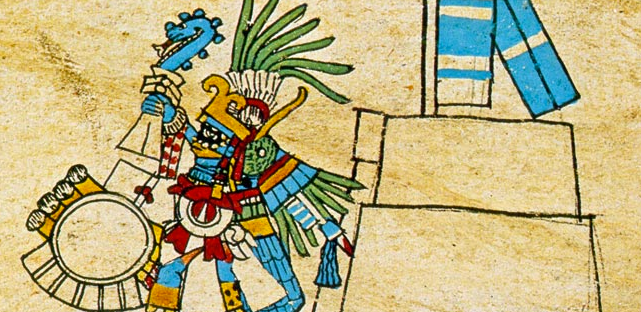
The feast of Panketzaliztli celebrates the winter solstice and the birth of the new Sun as Witzilopochtli (Hummingbird on the Left), one of the principal Teteoh honored by the Mexika. The name Panketzaliztli translates as “Raising of the banners.”

The festival of Panquetzaliztli is celebrated with dance, music, and a foot race. An effigy of Witzilopochtli is constructed from amaranth flour and agave nectar, and consumed after the race as an integral part of the festivities. Tamales are also made and eaten, and mock battles in honor of the season are waged between students of rival telpochkallis (schools). Small paper banners are set up in homes. During the entire twenty days, gratitude is shown towards all trees and plants for providing fruits, grains, herbs, firewood, etc., and they are adorned with decorations in the form of painted banners fabricated from strips of papel de amate (bark paper).

Primeros
Primeros Memoriales

As we see in the florentine Codex, the act of giving charity was also encouraged during this time:

“Respect the unfortunate old men, the unfortunate women, the miserable, the poor; take pity upon them. Give one somewhere perchance a poor, worn, breech clout, a miserable netted maguey cape; tie, wrap them about him; give him something to drink. For he is the representative of the master, our lord. For this thou shalt be given life on earth…”

The Florentine Codex, Book 9, Chapter 12, p.56-57

The feast of Panketzaliztli and the birth of Witzilopochtli serves as the basis for the Mexican tradition of “Las Posadas.”

Las Posadas began in 1587, in the town of San Agustín Acolman, 40 kilometers from Teotihuacan, when Fray Diego de Soria obtained a permit granted by the then Pope Sixtus V in which he gave the celebration in New Spain of the Christmas mass.”

These liturgical acts that would serve to evangelize the natives were carried out from December 16 to 24 in the atriums of the temples. Among these ceremonies it was customary to fuse passages and scenes representative of the Nativity. Taking advantage of the inclusion of gunpowder to Mexican lands, the celebrations were illuminated with sparklers, rockets; as well as the piñatas, songs and carols.

However, this way of Christianizing the natives of Mexiko-Tenochtitlan was not completely unknown by the settlers. While the Spaniards and part of Europe were waiting with allegory for the birth of Jesus, the inhabitants of Anahuac (Valley of Mexico) were preparing simultaneously to receive the Sun Child.

How did such a similarity to Catholicism occur?

The researcher Germán Andrade Labastida discovered in 1942 that “The Aztecs celebrated with great pomp the birth of Huitzilopochtli (” hummingbird of the south “or” left hummingbird “), and this ceremony was precisely at Christmas time, at night and at day next there was a party in all the houses, where the guests were given succulent food and small figurines or idols made of blue corn, roasted and ground, mixed with black maguey honey.”

Indeed, every year, during Panquetzaliztli a feast (mitote) was celebrated in honor of Witzilopochtli, the Sun Child, to solemnize his birth on the solstice.

According to Amaranta Leyva, “the ceremony began with a race led by a very fast runner who carried in his arms a figure of Huitzilopochtli made of amaranth and wearing on his head a blue flag (pantu) (texuhtli)”.

It started in Huey Teocali (great house of the sun) and reached Tacubaya, Coyohacan (Coyoacán) and Huitzilopochco (Churubusco). Behind the carriers of this image ran a crowd that had been prepared with fasting.

During the Winter Solstice (December 21), the sun had already crossed the celestial vault and had died on December 20. El Niño Sol went to Mictlán (Place of the Dead) where it was transmuted as a hummingbird to return to the origin.

Just at that time, other ceremonial acts occurred: the Mexika installed banners of paper on all the fruit trees and edible plants of the season. On the day of the party, all the trees were cured and pulque (meoctli) and tortillas (tlaxcalli) were offered, as a token of gratitude for what was harvested during the year.

Screen Shot 2017-12-06 at 3.32.01 PM.png
Panketzaliztli in the Tovar Codex. In this illustration, from the third section, an old and emaciated man holds a banner decorated with blue stripes and pennants. He wears a necklace of blue beads with gold pendants. Above the man’s head is a goat. The text describes the month as being one in which the war captains celebrate. Identified as December with the astrological symbol of Capricorn, the month is called Panquetzaliztli (Banner Raising). It was dedicated to Huitzilopochtli, the god of the sun and war. The blue color may be associated with this god, whose name means “Blue hummingbird on the left.”

Historians and specialists in the prehispanic culture of Mexico, highlight that this cult is an analogy with the posadas at the time of breaking the piñata.

In his memorials written in 1541, Fray Toribio de Motolinía narrated that for the Christmas celebrations, the natives adorned the churches with flowers and herbs; They scattered sedge on the floor, made their entrance dancing and singing and each carried a bouquet of flowers in his hand.

In the eighteenth century, the celebrations took more force in the neighborhoods and in the houses and the religious music was replaced by the popular song, but they did not stop being realized in the temples.

Among Christmas carols, piñatas and celebration, the inns are part of the ancestral spirit of Mexican culture.

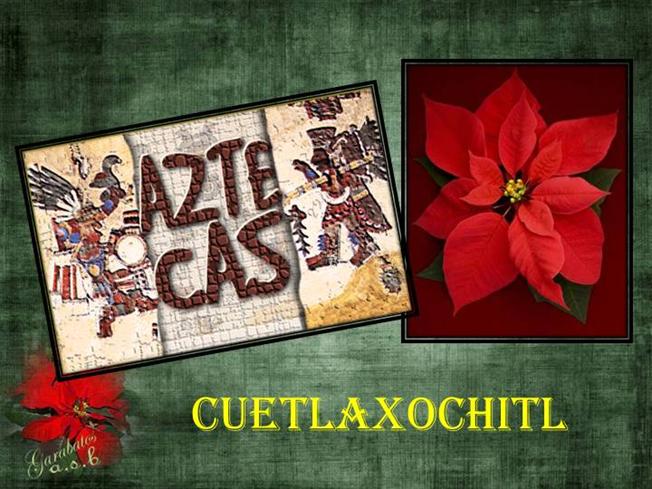
Of course, another important aspect of this celebration is the use of Cuetlaxochitl (poinsettias) in ritual and decoration. This plant blooms in the wintertime, and its flowering is seen to represent the rebirth of the sun. The bright red petals representing the preciousness of the blood that is offered to Witzilopochtli.

2022148_635226066450095000

Screen Shot 2017-12-06 at 3.31.29 PM.png

Interested in learning more about Mesoamerican ritual and cosmovision? Check out our new book “Our Slippery Earth: Nawa Philosophy in the Modern Age” available on Amazon.com. In it, I discuss basic themes of Nawa philosophy, and how these themes can be practiced in the modern age.

our_slippery_earth_cover_for_kindle
Click to Purchase

Kurly Tlapoyawa is an archaeologist, author, and ethnohistorian. His research focuses primarily on the interaction between Mesoamerica, Western Mexico, and the American Southwest. Kurly has lectured at UNLV, University of Houston, and Yale University on topics related to Mesoamerica. His recent book, “Our Slippery Earth: Nawa Philosophy in the Modern Age” was published in 2017. In addition to his work in Archaeology and Ethnohistory, Kurly is a professional stuntman with over 35 credits to his name.

Follow Kurly on twitter @KurlyTlapoyawa

Enjoy this article? Become a patron and support independent, Indigenous media!

Monthly Rituals

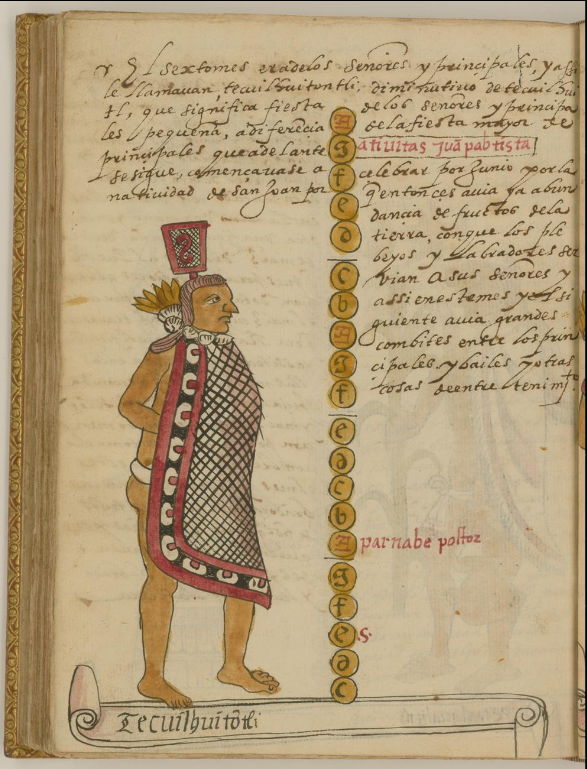
Tekwilwitontli

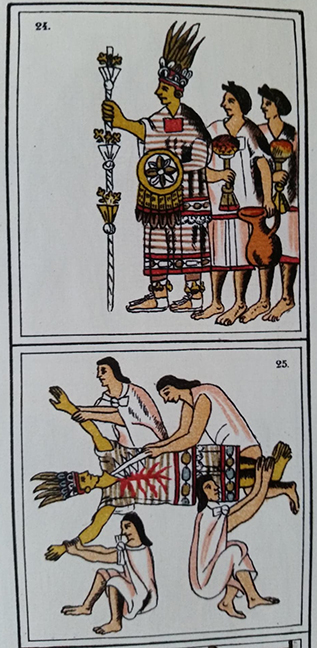
On the first day of this month they celebrated a feast to the female Teteoh of salt, whom they called Wixtoziwatl. They said that she was the elder sister of the Tlalokeh. In honor of her, they slew her female representation (ixiptla).

From the Florentine:

“On the eve of this feast, all the old women sang and danced, as well as the young women and girls. They went held by some short cords which they carried in their hands, one [taking] one end, another the other [end]. These cords they named xochimekatl. They all wore garlands of wormwood [flowers] of this land, which are called iztawiatl. Several old men led them and ordered the singing. Among them went the woman who was the likeness of this goddess and who was to die arrayed in rich ornaments.

On the night before the feast, the women, with the same one who was to die, kept vigil; and they sang and danced all night long. At break of day, all the priests arrayed themselves and performed a very solemn dance. And all who were present at the dance held in their hands those flowers which are called zempoalxochitl. Thus dancing, they took many captives to the teokalli of Tlalok, and, with them, the woman who was to die, who was the likeness (ixiptla) of the goddess Wixtoziwatl. There they slew first the captives and then her.

Many other ceremonies were performed during this feast; and also [there was] great drunkenness, all of which is set forth at length in the account of this feast.”

Book 6 chapter 7 p 33

Modern Interpretations of Tekuilwitontli (adapted with permission from the work of micorazonmexica):

Today there is no longer a class of noblewomen to celebrate Tekuilwitontli in the ancient way. But, falling as it does in the heart of Xopan, during the period when the power of the mother/creation Teteoh are at Their height, it is appropriate for all women to celebrate their many gifts, and for men to honor them and join in their feasting. A tlamanalli (ofrenda) should be made on which the Teteoh are arrayed, beneath a bower of flowers, and offerings of food placed before them. The women should wear their most beautiful regalia in a thousand colors, and paint their arms and faces yellow, with red lips and spots of red upon their cheeks, while the men, if men are present, should dress simply, in white. Amaranth cookies shaped like moons and rabbits, cooked squash-blossoms on blue-corn tortillas, tamales, and other delicacies, are served at a feast, in which the women first dance with one another, and only after permit the men, if they should deign to invite men, to join them.

Tekuilwitontli is also sacred to Wixtoziwatl, Salt Woman, who is Our Lady Salt, Our Lady the Sea. She is a sister of the Tlalokeh, who at the dawn of time battled with Them. She was defeated, and cast into the sea, and Her body of salt dissolved and became the brackish lakes and the water in the ocean. During the season of rain, we give honor to Our Mother the Sea, for without Her we cannot live, and She is honored for Her life-giving salt. If you live near the sea, you should go to the seashore, and give offerings and ceremonies to Her. We have mistreated Her with pollution, endless rivers of plastic, overfishing, and all of the other cruelties we have thoughtlessly inflicted upon Her. She is angry, and now threatens to flood all the shores of the world. Give Her praise and thanks for Her abundance, dance for Her, cast drops of your blood into Her waves, and brilliant flowers which give Her joy, and then volunteer to pick up trash, or save sea-turtles, or give up eating non sustainable sea-food, or donate money, or in some other way sacrifice for Her, and give back to Her some small part of what She has given to you.