
The eighth month they called Wey Tekwilwitl. On the first day of this month they observed a feast to the female Teteoh named Xilonen (the Teteoh of the tender maize). On this feast they gave food to all the poor men and women – old men, old women, boys, girls – in honor of this Teteoh. They slew a woman, on the tenth day of this month, arrayed in the ornaments with which they represented the same Teteoh.
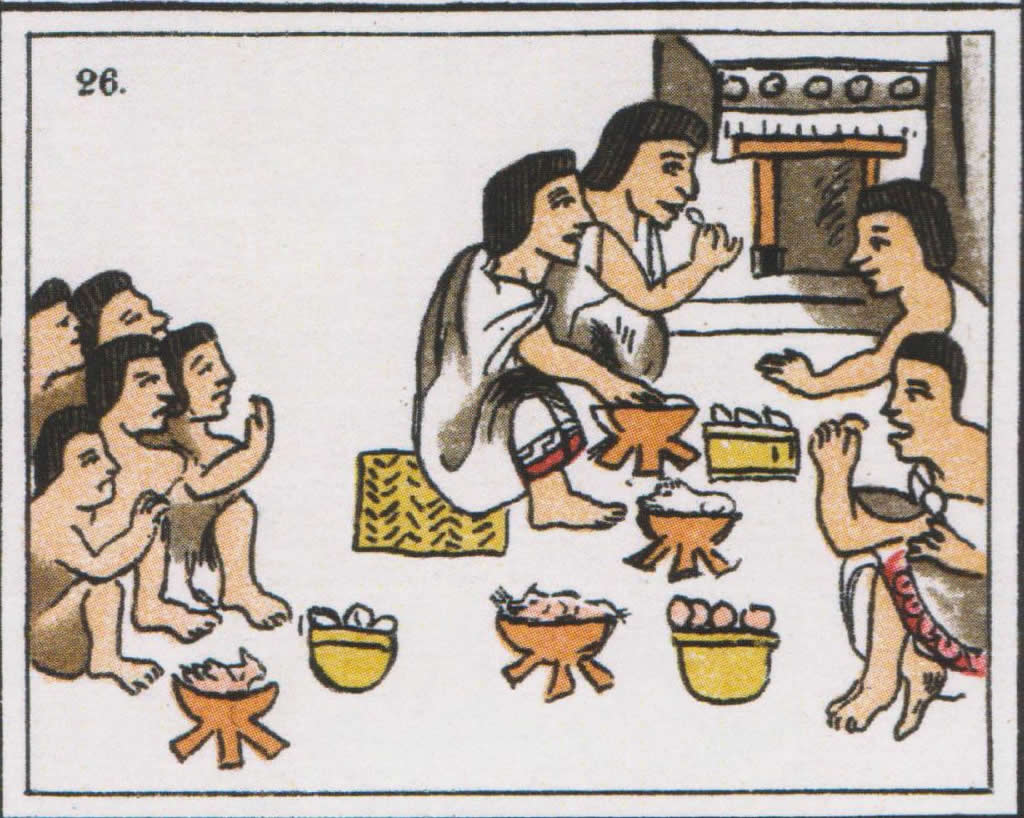
From the Florentine Codex (Florentine Codex, book 2, page 14):
“For eight uninterrupted days before the feast, they fed men and women, young and old. Then, very early in the morning they gave them to drink a kind of gruel which they call chienpinolli. Each one drank as much as he wished. And at noon they placed all in order, seated in their rows, and they gave them tamales. He who gave them [out], gave each one as many as he could hold in one hand. And if one of them exceeded the bounds of custom so much as to take [tamales] twice, they mishandled him and took from him those which he had, and he went with nothing. This [feasting] the lords brought about in order to give comfort to the poor; for at this time, ordinarily, there is a want of the necessities of life.
All these eight days they danced and moved in rhythm, men and women together performing the ceremonious movement, all heavily adorned with rich vestments and jewels. The women wore their hair unbound; they went with hair down, dancing and singing with the men. This dance began at sunset, and they continued in it until nine o’clock. They carried many lights (like great torches) of resinous wood, and there were many braziers or bonfires which burned in the same courtyard in which they danced. In this dance or solemn movement they went with hands joined [to those of other dancers], or embraced-the arm of one grasping the body of another as in an embrace, and the other likewise [holding still] another, men and women [alike].
One day before they slew the woman who was to die in honor of the goddess Xilonen, the women who served on the pyramid (who were called Ziwatlamakazkeh) performed a dance in the courtyard of this same temple, and sang the [hymns of] praise and the canticles of this goddess. They all went surrounding her who was to die [and] who went bedight in the ornaments of this goddess. In this way, singing and dancing, they kept watch all night before the day when she was to die.
And at dawn all the nobles and warriors performed a dance in this same courtyard, and with them also danced the woman who was to die, with many other women arrayed like her. The men went dancing in front, by themselves, and the women went behind them.
As soon as all, thus dancing, arrived at the pyramid where that woman was to die, they made her go above, up the steps. When she reached the top, one [of the priests] took her upon his back, shoulder against shoulder; and in this position, they struck off her head and then tore out her heart and offered it to the sun. Many other ceremonies were enacted in this feast.”

Modern Interpretations of Wey Tekwilwitll (adapted with permission from the work of micorazonmexica):
This is a time for those who are privileged and wealthy to contemplate their good fortune, and to pay back their debt. To be wealthy is relative. Unless you are homeless, or struggle to put food on the table, or find yourself unable to pay your rent or for the education of your children, you are wealthy. Your wealth may not be so great as that of your neighbor, but it is far greater than those less fortunate than you, who never had the opportunities you had, or who were brought down by the tricks and terrible mischievousness of Tezkatlipoka, such as alcoholics, or drug addicts, or people with mental health issues, and any other who has lost their way or never had an opportunity and consequently lives in poverty. Rather than judge others for having fallen, you should thank Tezkatlipoka for not having led you down the path He led them, for it is only through the tricks of destiny Tezkatlipoka plays upon us that some fall and others succeed.
During this time, late in the rainy season, many of the common people had eaten most of the corn they had stored since the last harvest, but the new harvest was still unripe in the fields. Therefore, even as the earth bloomed, the people often went hungry. The feasts of Wey Tekwilwitl were a way for the wealthy to aid their poorer neighbors, and to help make it through that last difficult moment before the maize ripened. None who came to the banquets were turned away, and all joined in the dancing and merriment.
Therefore, we should volunteer at homeless shelters or perhaps invite immigrants at a shelter to a feast or find other ways to help the poor and hungry, each according to our means, for the greater our wealth, the greater our responsibility. We look to the blooming of Our Mother the Earth and Zenteotl the Corn as He ripens on the stalk, and strive to be like Them, who give their fruit to any who tend the soil, and who provide for all Their children.
Xilonen, who is another manifestation of the maize, is also honored on Wey Tekwilwitl. Xilonen is the young corn-plant, newly sprung from the earth. She is the tender stalk, yet to bear fruit. She is placed on the altar, together with Zenteotl, and given offerings of yellow fruits and yellow flowers. We dance for Her, the women in an inner circle closest to Her image, and the men in the outer circle, and all hold yellow flowers in one hand, and stalks of corn plants in the other. all wear crowns and necklaces of yellow flowers as well. The participants paint their faces with pyrite powder, or, if such cannot be obtained, with golden glitter. All who feel so called pierce their fingertips, tongue, or ear-lobes with maguey spines, and sprinkle their blood on strips of paper, which are offered to Xilonen, and later burned. A feast is then held for those who have participated, with much drinking of pulque, merriment, and joy, as all gathered cry out in thanks to Xilonen for Her gift of maize and life.
Xilonen, who is another manifestation of the maize, is also honored on Wey Tekwilwitl. Xilonen is the young corn-plant, newly sprung from the earth. She is placed on the altar, together with Zenteotl, and given offerings of yellow fruits and flowers. We dance for Her, the women in an inner circle closest to Her image, and the men in the outer circle, and all hold yellow flowers in one hand, and stalks of corn plants in the other, and all wear crowns and necklaces of yellow flowers. The participants paint their faces with pyrite powder, or, if such cannot be obtained, with golden glitter. All who feel so called pierce their fingertips, tongue, or earlobes with maguey spines, and sprinkle their blood on strips of paper, which are offered to Xilonen, and later burned. A feast is then held for those who have participated, with much drinking of pulque, merriment, and joy, as all gathered cry out in thanks to Xilonen for Her gift of maize and life.
 The Mexika Calendar System